As we begin 2026 with renewed vigor and clarity of purpose, it’s valuable to look back at the year that was for FreeHydroCells. Reflecting on 2025 reminds us not simply of what we did, but who we met, what we learned, and where we are now in the journey toward sustainable, community-oriented green hydrogen production.
In many ways, 2025 was a year of building bridges – between disciplines, between labs and communities, and between project ambitions and global research conversations. This blog recounts those moments and reflects on how they shape FreeHydroCells’ trajectory.
January – Starting with Civic Engagement
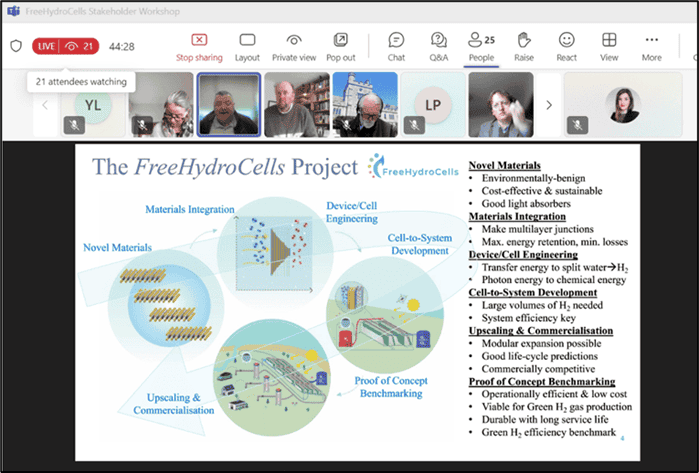
We began the year focusing on the social dimension of energy transitions. In January, we partnered with UCC Civic and Community Engagement to host an online workshop titled Future of Green Hydrogen: Challenges and Possibilities. This was much more than a project update – it was a conversation with 30 community stakeholders, researchers, and industry partners about real expectations and barriers for green hydrogen beyond academia.
The discussions highlighted gaps in public understanding, questions around industrialisation, and opportunities for collaborative research. The workshop not only helped set our priorities for the year but also seeded relationships that continue to inform our outreach. The full summary report is available here.
March – Sharing our Vision with Future Scientists
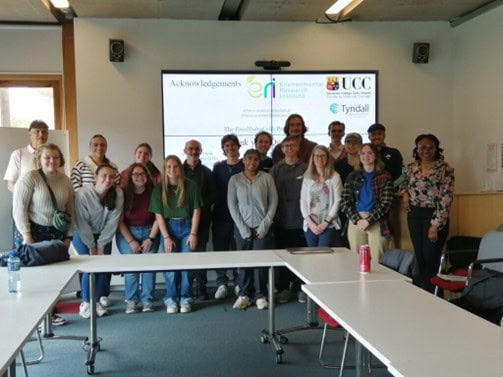
In March, our FreeHydroCells Coordinator Dr. Ailbe Ó Manacháin (UCC) engaged directly with the next generation of scientists. He delivered a presentation for an undergraduate cohort from the University of Minzu titled “Pathway to Green Hydrogen Fuel through Novel Materials, Water and Light.” This session introduced students to the broader scientific and societal context of renewable energy research and connected them with real ongoing work within FreeHydroCells.
May – Springing into International Research Dialogues
PhD candidate Vittoria Anastasi (CNR-IMM) shared her research at the WindValue Summer Research Seminar in May. This event brought together scholars working at the intersection of wind energy and sustainability, offering a platform to connect hydrogen research with broader renewable systems thinking – particularly around how intermittent renewables like wind can be aligned with hydrogen production strategies.
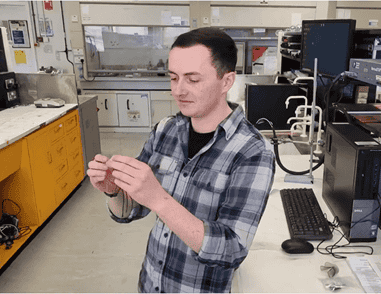
May also saw FreeHydroCells represented at the 247th ECS Meeting in Montréal, Canada, where Dr. Matthew Ferguson (UCC) presented on innovations in 3D-printed micro-lattice electrodes for water splitting.
The ECS meeting is one of the world’s premier gatherings for electrochemistry and solid-state science, bringing together scientists, engineers, and industry experts from around the globe. Attendees explore advances in materials, devices, and processes that underpin technologies from batteries to sustainable fuels. It uniquely blends discussion formats including talks, panels, short courses, and workshops, making it a dynamic hub for interdisciplinary exchange.
Matthew reflected that presenting there was “a privilege” and that the dialogues sparked by the conference broadened perspectives on how our materials work can contribute to wider discussions in water splitting and hydrogen research.
July – National Conversations & Recognition
Christopher Kent (UCC) presented at CASI (Conference of Analytical Science in Ireland), engaging an audience of ~170 attendees on the topic of optimising water electrolysis using advanced spectroscopy. This was an opportunity to share project insights with analytical scientists and open new avenues for technique-driven refinement in our experimental approaches.
FreeHydroCells Labs were also recognised for sustainable laboratory practices, joining Ireland’s Green Lab Leaders. This milestone reflects our commitment not only to sustainable outcomes in hydrogen science but also to embedding sustainability in how we operate day-to-day.
September – Making Connections at the 5th International Solar Fuels Conference
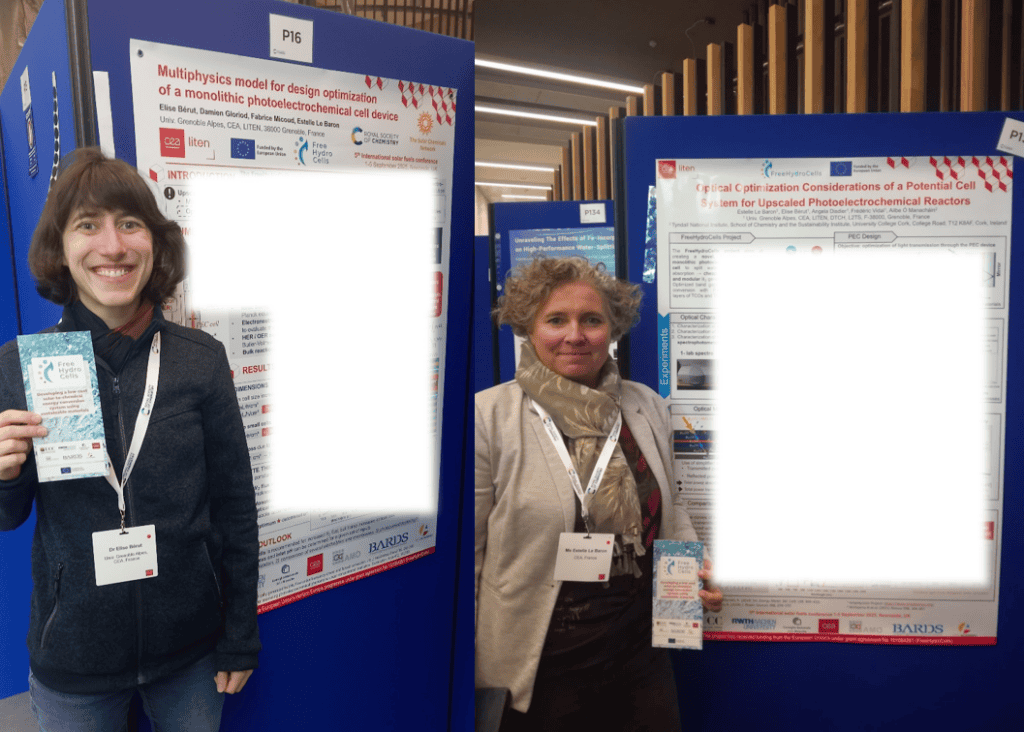
In September, Dr. Estelle Le Baron and Elise Bérut (CEA) represented FreeHydroCells at the 5th International Solar Fuels Conference in Newcastle, UK. This event, hosted by the Royal Society of Chemistry, is a key forum for solar fuels researchers from around the world. It features both early-career and main scientific programmes, with oral and poster sessions that span inorganic and organic photoelectrode development, electrocatalysis, bioinspired systems, and devices for deployment. The conference is designed not just for knowledge exchange but for fostering interdisciplinary collaboration on solar-driven fuel production, including hydrogen pathways.
Estelle and Elise showcased their work on multiphysics models and optical optimisation for photoelectrochemical cells, situating our research within global efforts to scale light-driven fuel systems.
October – Continued Electrochemistry Presence
Dr. Ian Povey (Tyndall National Institute) presented at the 248th ECS Meeting on atomic layer processing of doped metal oxides and dichalcogenides – exploring material innovations that intersect with the core objectives of FreeHydroCells: better, scalable interfaces for energy conversion.
November – December – Highlighting Materials Innovation at MRS Fall Meeting
Wrapping up the year, Nino Marino of Consiglio Nazionale delle Ricerche (CNR) delivered an oral presentation at the MRS Fall Meeting 2025 on scalable electrodeposition of few-layer MoS₂ for high-efficiency optoelectronics – work that dovetails with efforts to harness light and material structure for improved hydrogen production systems. Dr. Stefania Privitera also attended, underscoring the collaborative and cross-institutional nature of our engagement.
Looking Forward
2025 was a year of presence – showing up where the conversations were happening, contributing where our insights mattered, and learning from others doing remarkable work in related fields. From community dialogue in January to international forums across continents, FreeHydroCells strengthened its network, sharpened its research focus, and aligned more closely with global efforts toward sustainable fuels.
For a deeper look at the project’s outcomes, impacts, and the people driving FreeHydroCells forward, catch our 2025 Annual Newsletter released in December.