
With the end of the FreeHydroCells project (31st August 2026) rapidly approaching, the recent project plenary and general assembly provided an opportunity to not only review the latest scientific results to finish out the project, for reporting activities, but also to reflect on the remarkable achievements of the project as a whole so far.
High Risk, High Reward
From the very beginning, as highlighted in the call text and the proposal Grant Agreement, FreeHydroCells was recognised as a high-risk, high-reward project. The scientific ambition was considerable, and many of the project’s objectives required researchers to work at the very frontier of the state of the art of the technology and to think outside the box to find solutions. And as readers of these blogs will know, the project teams have consistently risen to meet these challenges.
As our project leader, Dr Ailbe Ó Manacháin of UCC, explains:
“The level of novelty developed in the project has been astonishingly high, despite the demanding challenges posed by the high-risk/high-reward designation in the Horizon Europe call documentation.”
Perhaps one of the project’s greatest achievements has been transforming an ambitious scientific vision into a validated technological platform at an intermediate stage in the project to build upon. What initially appeared more than uncertain – improbable actually – has gradually and painstakingly evolved into an entirely novel and advanced technological platform with the ability to test the proof of concept verification criteria originally envisaged. Think about that – we had around a dozen state-of-the-art bottlenecks to overcome to get to this point, and we are here ready to test our overall proof of concept verification. The non-confidential aspects of the results will be published in due course.
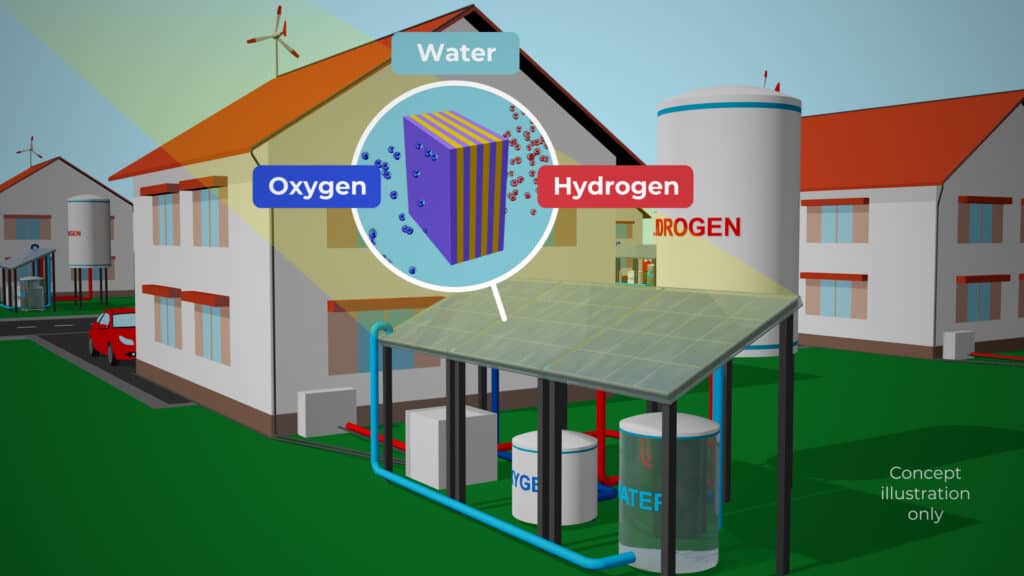
A Range of Successes
The scientific accomplishments of FreeHydroCells have been significant. Over the course of the project, and over the vast range of materials systems and configurations investigated, its members have accumulated a significant set of non-confidential results that could be published in top class journals, including:
- Enhancing the photocatalytic properties of devices based titanium dioxide (TiO2) by combining thin films of this material with glass substrates and forming nanoscale structures and testing different coverings of gold or aluminium. (Published paper)
- Assessing the photoelectric response of MoS2 layers sandwiched between conductive oxides, and seeing improved photocurrent effects for combined junctions made up of indium tin oxide, MoO3, MoS2, and fluorine doped tin oxide. (Published paper)
- Exploiting the broadband acoustic resonance dissolution spectroscopy (BARDS) method, developed by FreeHydroCells members prior to the project, to assess passively the efficiency of photoelectrochemical cells by tracking the gas evolution of hydrogen and oxygen within an electrolyte. (Published paper)
- The scaling of the developed technologies is dependent on optimising the light energy capture, and a study was carried where light attenuation in a photoelectrochemical cell was assessed to provide guidance on the most suitable materials. (Published paper)
- A range of 3D-printed coated microlattices was studied to determine which was the optimal form to be applied to architected electrodes for the most effective production of hydrogen. (Published paper)
A Team Effort
But none of these achievements would have been possible without the adherence to highly integrated methodological approaches transcending across all partners and teams seamlessly due to the extraordinarily strong collaborative and confidential trust that defined the consortium. Throughout the project, partners from different disciplines, institutions, and countries worked closely together, openly sharing expertise, discussing challenges, and collectively developing solutions to complex scientific problems, while at the same time enhancing their own scientific and technical expertise.
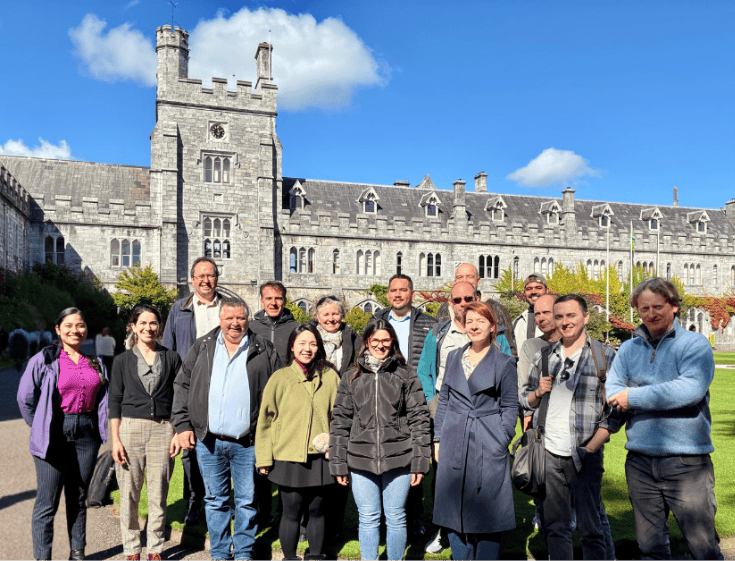
Communication proved to be one of the consortium’s greatest strengths. Regular meetings, scientific exchanges, and ongoing collaboration ensured that knowledge flowed efficiently between partners and that everyone remained aligned with the project’s goals. This multidisciplinary environment not only strengthened the quality of the research but also created valuable opportunities for learning and innovation.
The project has provided outstanding opportunities for early-career researchers, particularly doctoral students, who have gained invaluable experience through participation in such a challenging and groundbreaking initiative. As Dr Vittoria Anastasi of CNR and the University of Catania, who featured in our October 2025 blog and who recently successfully defended her doctoral work, reflected:
“Being part of an international team has been amazing. It has shown me that collaboration across countries can drive real innovation. I have never been part of something like this before. It is amazing to see so many brilliant people working together – everyone contributes something unique. It is inspiring. Sometimes I look around and think, ‘Wow, look at all these incredible minds working for one shared goal.”
FreeHydroCells has also benefited from the highly active involvement of its SME partners, AMO from Aachen, Germany, and BARDS from Cork, Ireland. And as Dr Dara Fitzpatrick of BARDS has noted:
“The objective itself – developing green energy solutions – is very compelling. There is also the potential to democratise energy production, particularly in developing regions. That is a powerful idea. And beyond that, the whole team across all partners has been excellent. There has been a real sense of teamwork commitment; even when challenges came up, we solved them together. Seeing tangible progress has been very rewarding.”
[Read related blog: Listening to Gases: A Conversation with Dr. Dara Fitzpatrick]
What all this has led to is a consortium which is more than willing to work together on future projects where the advancements developed so far can be pushed further. This may lead to further developments which, hopefully, will help to see the vision of effective green hydrogen production for pollution free energy.
There is still more to come before FreeHydroCells concludes as it completes its proof-of-concept verification and evaluates its level of impact, so stay tuned for future updates as we approach this project’s final chapter and reflect on the future.